Voicing Hand
In the context of the forming chords on the fretboard, the terms ‘voicing’ and ‘fingering’ are easily conflated however they are not synonymous. Voicing refers to the musical spacing within a chord, that is, the intervals between notes within a chord. Fingering refers to the physical placement of fingers on the fretboard. ‘Position’ is another term often used in this discussion and refers to the placement of a voicing on the fretboard. The same voicing can often be achieved with multiple fingerings and multiple positions. Individual pitches can occur at multiple points on the fretboard as discussed in the fretboard page.
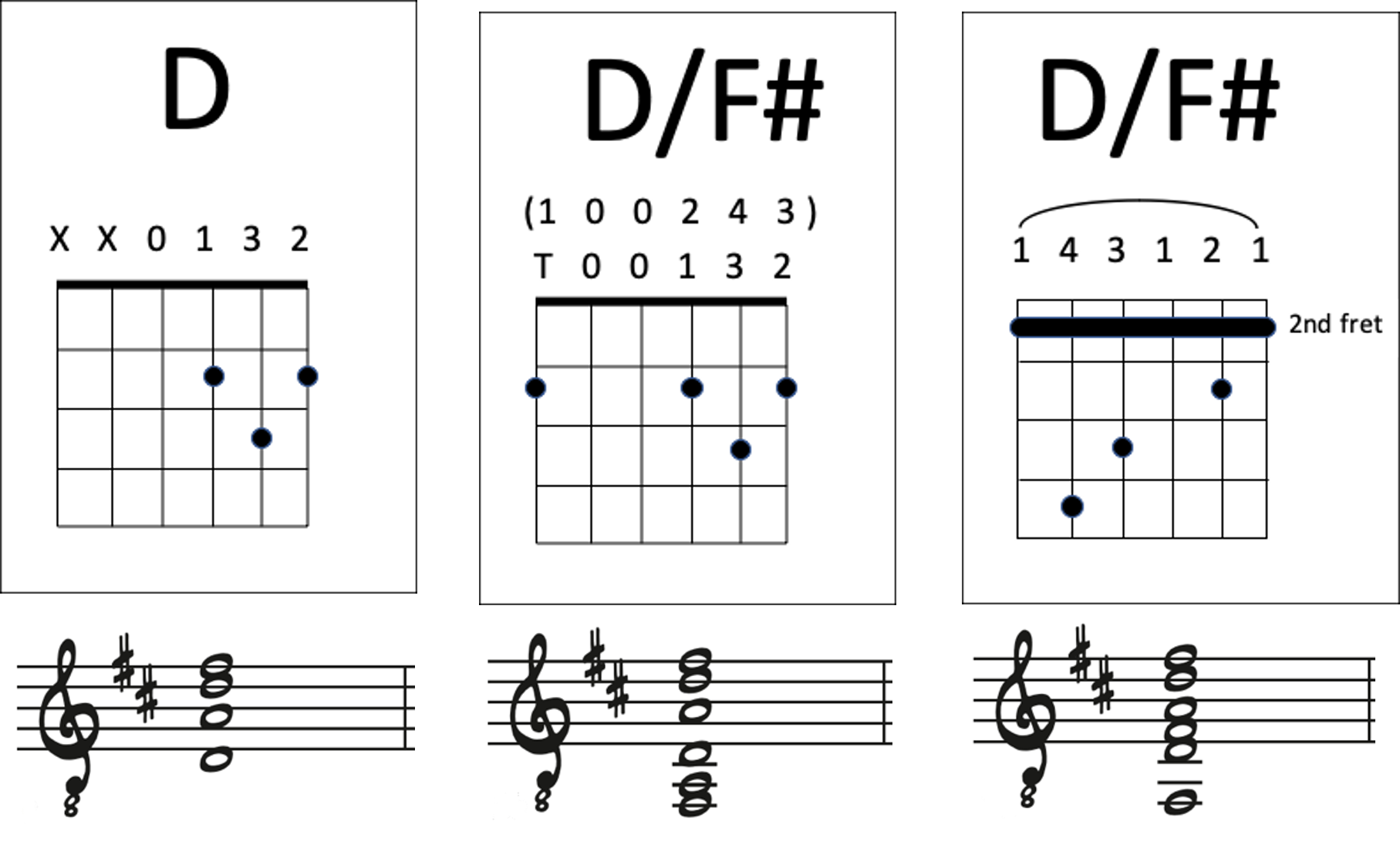
This diagram compares voicing and fingering between the root position and first inversion voicings: a root position D major, a thumb-over D/F#, and a barre chord D/F#. The voicings are spelled out on a stave below each diagram – note the four notes from the original voicing are maintained throughout the second and third voicings, however, various additional notes are added to thicken the harmonic texture utilising two contrasting methods. The second voicing also contains an alternative fingering where the first finger is used in lieu of the thumb.
It is important to consider all six strings particularly when strings remain unfretted to avoid unintended dissonance. The first chord presented in this illustration is the typical D major fingering and voicing which most guitarists learn early in their guitar career. This chord is easier to play in the voicing hand as it only requires the first three fingers and they only need to play notes on the first three strings. However, this chord is challenging for the expression hand for novice guitarists.