

Expression Hand
A slap strum is a percussive accent combining a heavy strum with the choking effect of a full mute on the strings rather than the bridge. Slap strums vary in intensity depending on the style and are often used to infuse energy into a strumming pattern. This first pattern features a backbeat pattern similar to the backbeat pattern on the accent page, however the slap strum is used instead of the accent.

Ob-la-di Ob-la-da
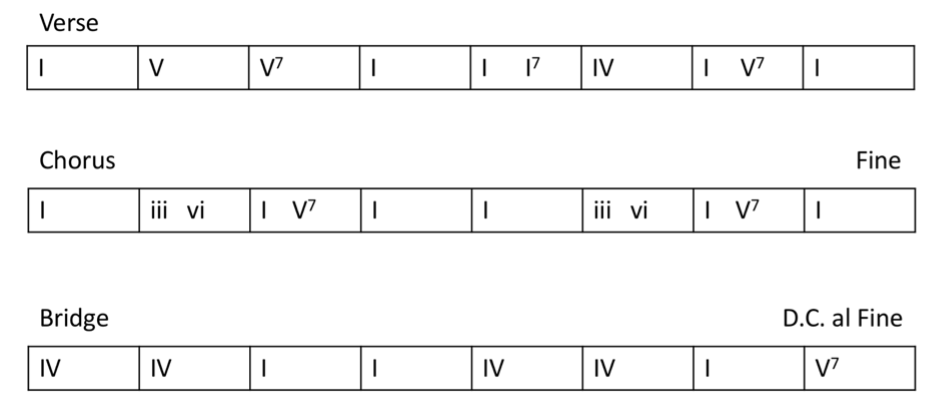
Lennon and McCartney’s Ob-la-di Ob-la Da typically features a bright bass line and a strong back beat. Using the slap strum pattern above play the chord progression below creates a similar bounce than instils momentum into the song. Participants were only supplied with the chord progression in Roman numerals to encourage harmonic independence and flexibility. The song was played in different keys at various points in the program as this type of flexibility is often required in music therapy applications.
Bossa nova
Bossa nova is a form of Brazilian jazz that features many layers to create an underlying syncopation. The pattern below features a rhythmic pattern that alternates between a bass line played by the thumb and triads played by fingers 1, 2 and 3. The understated syncopation in this pattern creates a sense of forward motion while maintaining a relaxed atmosphere. This rhythmic figure was applied the turnaround chord progression from the Pivot Fingers page and can be played either as one bar per chord, a four-bar phrase, or with each chord continuing for the full figure extending the phrase to eight bars.

Bossa nova rhythm often evolves as the song progresses through the form. A softer version of the slap strum can be used to lift the intensity as the Bossa nova gained momentum, however, rather than the hard percussive accent described above, it was replaced by a softer version of the slap strum. Used in this way, the slap strum acts more as a mute or tacet, creating somewhat of an anti-backbeat.
