Voicing Hand
Pivoting between chords
It may be stating the obvious, but changing finger positions when changing chords takes time. Complex and less familiar chord progressions can sometimes require more time, particularly for beginner guitarists as they navigate their fingers from one chord shape to the next. The resulting delays can accumulate, impacting on the consistency of the pulse and disrupting momentum.
One strategy to improve fluency is to minimise finger movement. Preventing unnecessary finger movement avoids the need to find their position for the next chord. This can be achieved by considering chord shapes in the context of the preceding and subsequent chords and identifying patterns to determine which fingers need to move and which fingers do not. Economical movement improves the fluency of the chord changes, which in turn improves consistency of the pulse.
To facilitate this, it is important to identify which fingers remain in the same position, which fingers move as a formation, and which fingers move independently. These patterns can then be used to pivot between chords. Navigational knowledge of the fretboard as illustrated in annotated fretboard assists in this approach: moving by one fret is an interval of one semitone and moving strings in the same fret in most cases is a perfect fourth.
Identifying pivot fingers help make chord changes faster and more accurate.
C Major to A minor
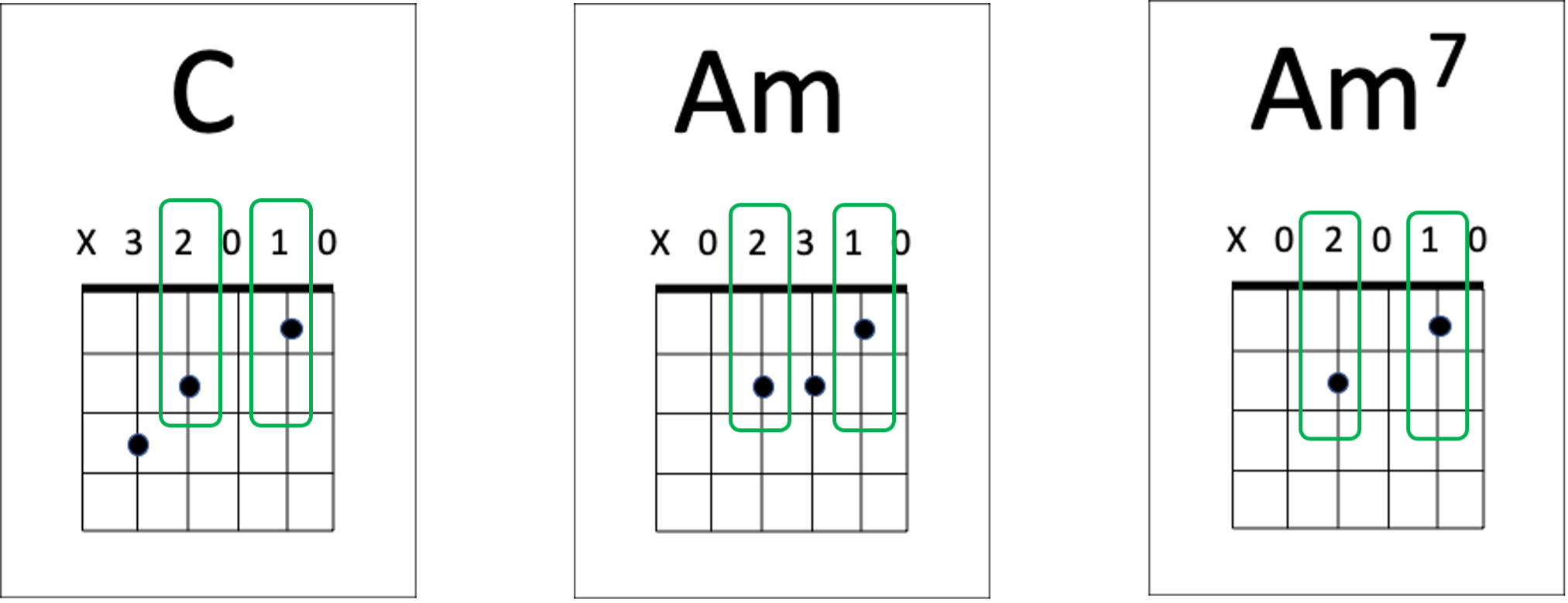
Changing from C major to A minor, the first and second finger in the green boxes act as a pivot. These fingers can stay in position, only the third finger needs to move from the 5th string 3rd fret to the 3rd string 2nd fret. If moving from C major to A minor 7, then the third finger can simply lift off as the remaining notes are played on open strings.
G Major to E minor
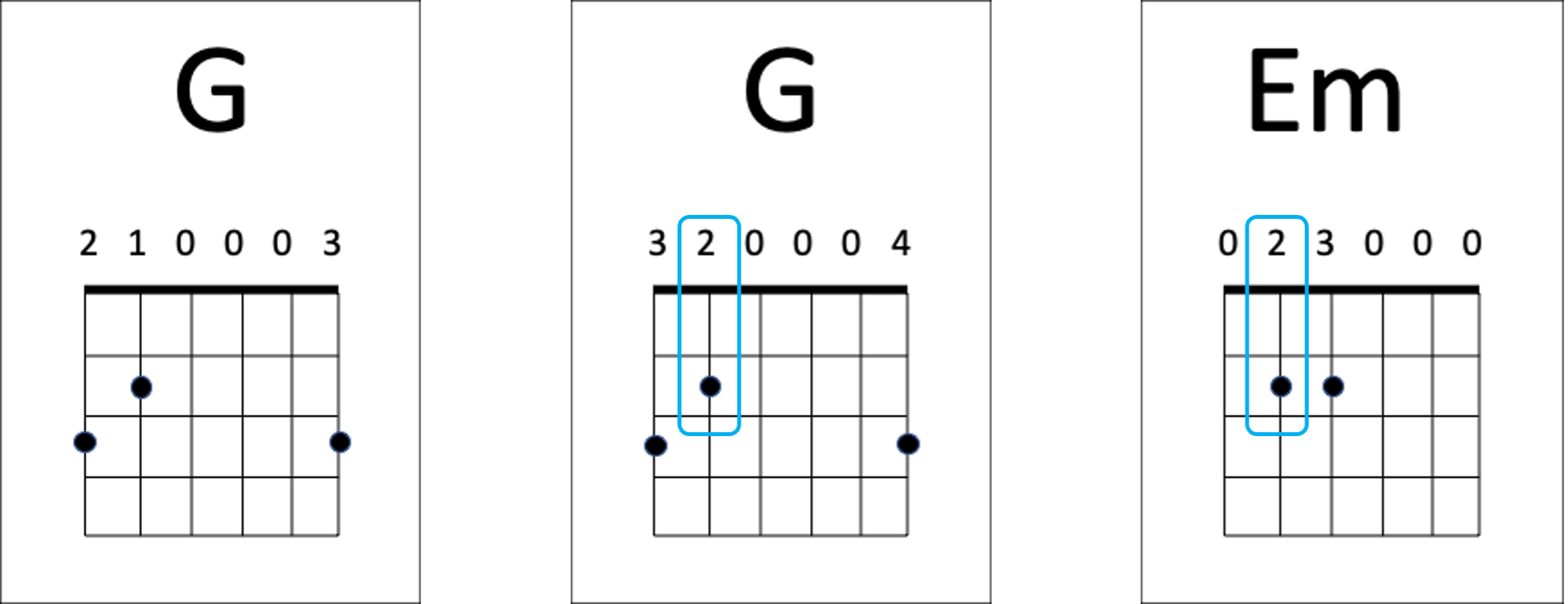
We can also adapt fingering to maximise pivot points. The alternative fingering strategy used in preparation for barre chords can also be useful in improving the fluency of chord changes when using open chords. Applying this technique to the G major in Figure 2 and using fingers 2, 3 and 4, the second finger acts as a pivot in the blue box when changing to E minor.
G Major to C Major
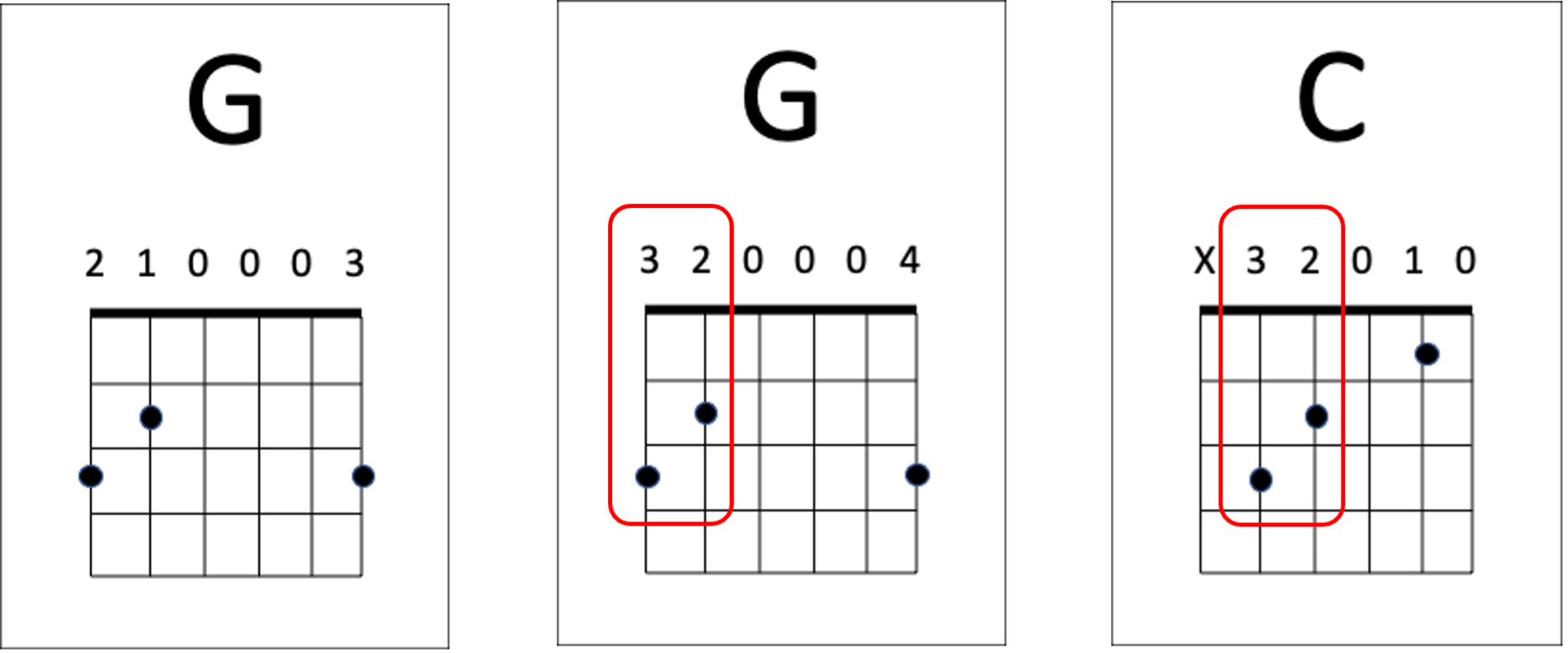
Applying the preparatory barre chord technique to G major and using fingers 2, 3 and 4, the second and third fingers form a modified pivot marked by the red box.
In this case, the pivot fingers move in formation up a string to form the C major chord as the interval between strings is a perfect fourth as illustrated in. The C can be completed by lifting the fourth finger and placing the first finger on the 1st fret of the 2nd string. Note pivot fingers may differ depending on the preceding and/or subsequent chord, even if the same alternate fingering is implemented.