Voicing Hand
Open chords only work in their standard position and cannot be moved up and down the fretboard without careful consideration of the open strings. As the chord shape moves up the fretboard the notes on the open strings do not move. This alters their relationship with the chord, creating suspensions that can alter the harmonic landscape significantly. Barre chords do not have this problem because there are there are no open strings.
However, barre chords (& power chords) are not the only chords that can move up and down the fretboard. For a chord to successfully move up and down the fretboard, it is essential to ensure only fretted strings are played. This does not mean all strings have to be pressed, however, it does mean that open strings should not be played for the chord shape to reliably move up and down the fretboard.
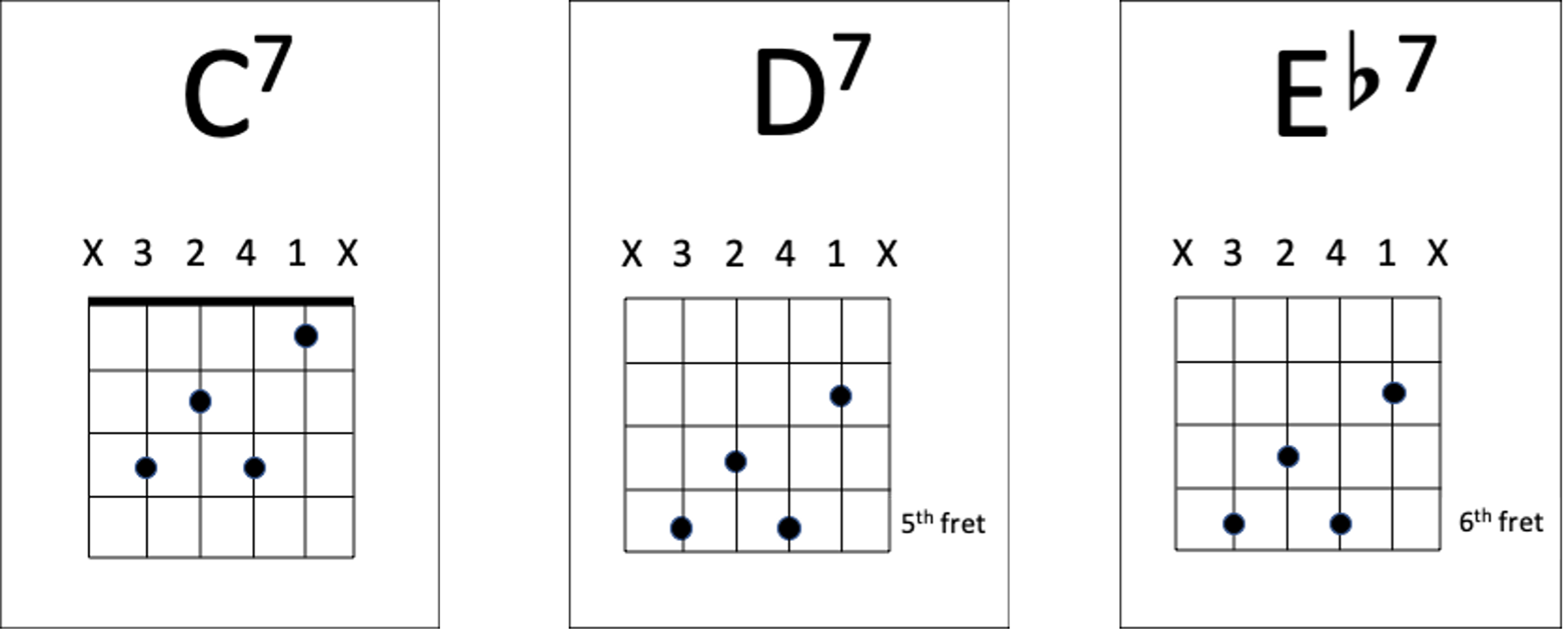
The C7 chord shape preserves the dominant 7th quality, providing the chord shape upholds the same formation as it moves up the fretboard, and the E strings are not strummed as indicated by the X in the diagrams. Moving the shape up two frets makes a D7 and one fret further makes Eb7.
C major has an E natural but, this would change the D7 to a D9, and Eb7 would become Eb7(b9). The E natural can be avoided by only strumming the middle four strings, though this level of accuracy is difficult. The E strings can also be muted: the 1st string can be muted with the soft pad of the first finger that is also playing the 2nd string as illustrated in Figure 75. The 6th string can be muted by reaching the thumb around the back of the neck and over the top.
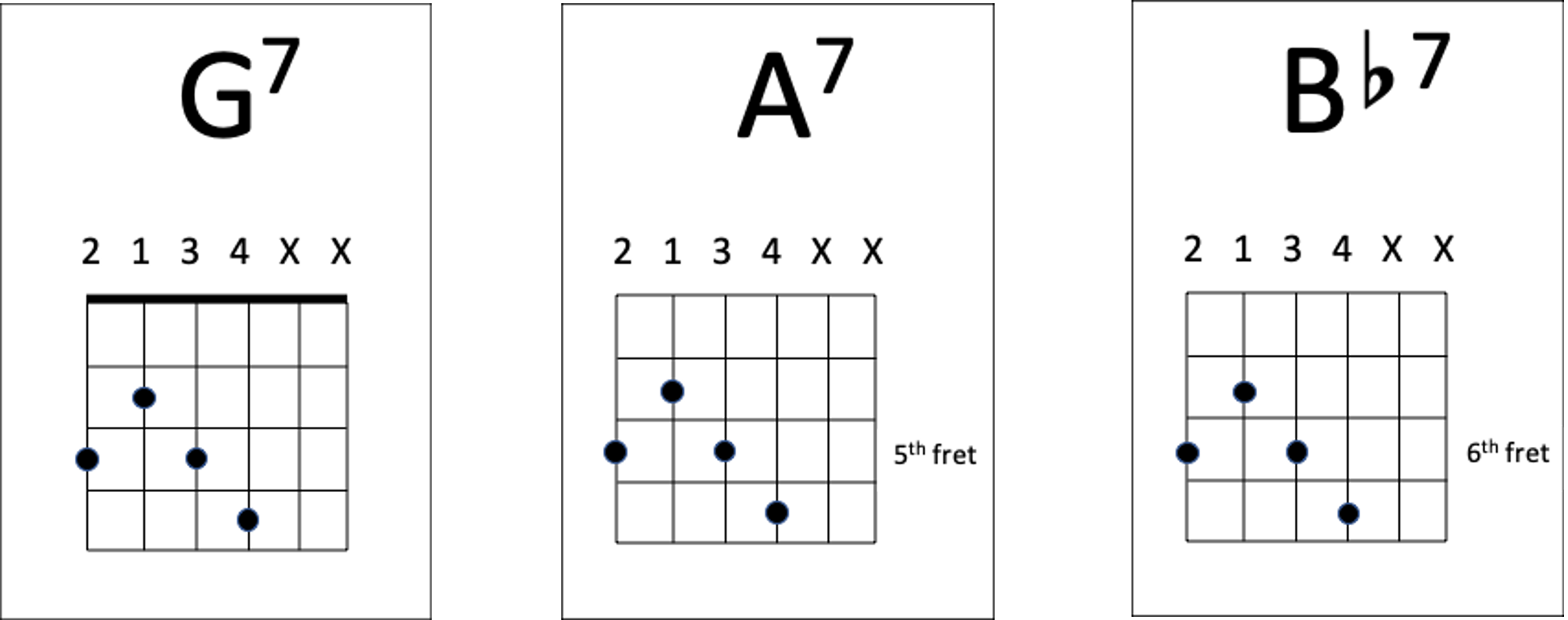
A similar concept based on G7. This fingering for G7 is not the typical fingering for G7, as the first two strings are muted. This fingering has been chosen as the chord shape does not include open strings and can therefore be moved up and down the fretboard. Moving the chord shape up two frets forms A7 and an additional fret to form Bb7.
With these 7th chords, it is possible to play a typical 12 bar blues progression using I IV V chords in the keys of G and D. The addition of Eb7 and the Bb7 facilitates more complex blues progressions by adding the bVI chord. One example is the Beatles’ “I Saw Her Standing There” in the keys of G and D. The verse and bridge use I IV V chords and the chorus uses a bVI chord.