Voicing Hand
The notes on a piano exist on a single plane from bass in the left, to treble in the right, and the pattern of the black notes help the pianist navigate the keyboard to find the note they need. Notes on the guitar are arranged on two planes. For right-handed guitarists, the frets ascend from left to right by semitones. Left-handed guitarists ascend from right to left (opposite to piano).
The notes on a guitar are also arranged vertically across the six strings. The interval between most strings is a perfect fourth (except G to B which is a major third). A further complication is that the strings are physically arranged in opposite order to the pitch. For example, the B string is physically above the E string, however, sounds a perfect fourth lower.
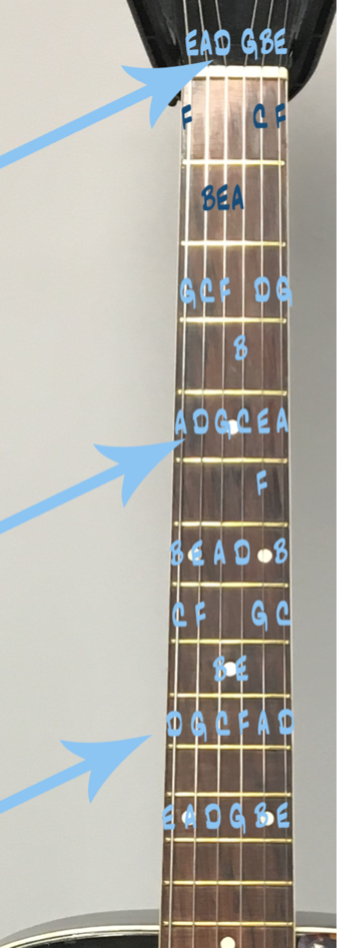
Both horizontal and vertical planes need to be negotiated to access all the notes on the guitar. Somewhat like a typewriter where the bell indicates it is time to reset the cartridge for the next line, the fifth fret is the same note as the next string played open as indicated by the arrows in Navigating by fourths and semitones was the first step to demystifying the layout of the fretboard.
The annotated photo of a fretboard features the ‘white note’ letters to demonstrate this pattern all the way up the fretboard and was used as a reference point when participants wanted to modify a chord shape to fine-tune their voicing. To demonstrate the pattern of 4ths, D was marked with an arrow at the tenth fret on the 6th string E, 5th fret on the 5th string A and open on the 4th string D.