

Voicing Hand
Familiarisation
Get used to the chord progression before introducing the scales and melody. Note the G major chord uses fingers 2, 3 & 4. This saves the first finger to play melody later.

Pivot Fingers
Use pivot fingers to help navigate the chord changes. This version of pivot fingers indicates which fingers transfer to the next chord. Check the Pivot Fingers page for further clarification including the colour-coded boxes.

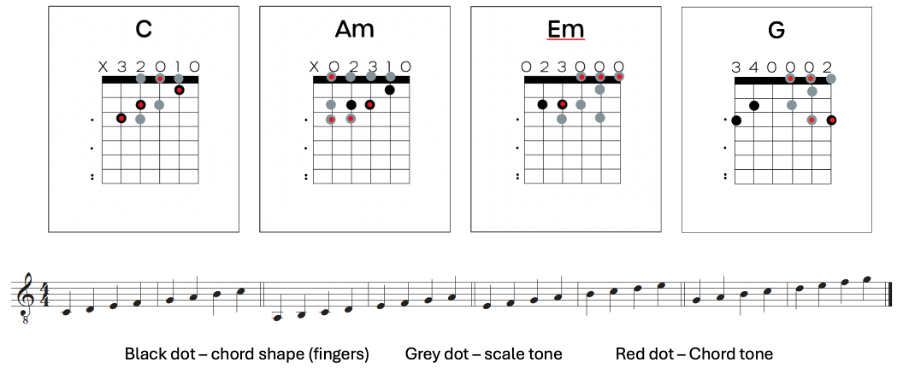
Matching diatonic scales to chords
Use pivot fingers to help navigate the chord changes. This version of pivot fingers indicates which fingers transfer to the next chord. Check the Pivot Fingers page for further clarification including the colour-coded boxes.
Ostinato accompaniment patterns
You don’t need to play all strings all the time. This first example shows standard fingering with all the strings played

In this next example, the treble E string is omitted (note the x on that string in the chord diagrams and the E (& G) have been removed from the score. The lower E string is only played when needed for the tonic, and then only for the first beat of the bar.

In this version of the ostinato, a repeated figure is added in the treble. Note the numbers illustrating the evolving roles of the G & E as the chords change.

From Little Things Big Things Grow
In this song, Carmody & Kelly used the same chord progression for the verse and chorus with different melodies.
Melody
• Try playing the melody on its own
• Add block chords
• Add an ostinato
Stretch
• Experiment with melodic variation
•Explore textural variation
• Explore harmonic improvisation – use the modes to match the chords as outlined above.
