

Expression Hand
Another way to vary the texture by rests or omitting some strums from the quaver pattern. It is important to maintain the regular down and up motion when strumming these patterns to ensure the down-strum remains aligned with the down beat. Some guitarists instinctively paused during these rests, however. this typically results in a loss of momentum and fluency in the strumming pattern. To play these rests successfully, alter the path of their strumming action by moving your hand slightly forward so they don’t make contact with the strings on those quavers.
This technique is referred to as the bypass strum as the expression hand maintains the down-up momentum of the strumming action, however, bypasses the strings on specific strums to apply the rest. the bypass strum was first introduced in the ska rhythm.

(so called) Music Therapy Strum.
Many music therapists i have work with recalled learning this pattern on their first placement and refer to it as the ‘Music Therapy Strum’. I have encountered this pattern as a universal strumming pattern in other settings with self-trained guitarists including church bands and open mic nights. I learned this pattern as a teenager playing music with a church-based youth group where it was referred to as “the Church Strum”.
I recall one of the other guitarists reciting the mantra “down-down-up-up-down-up”, instilling both the continuous down/up strumming motion with the rests on the second and fifth quavers of the bar.
Guitarists typically don’t pay close attention to the syncopation or the specific rhythm they were playing. However, we can move these rests around the bar to create a range of syncopated strumming patterns.
Experimenting with syncopation
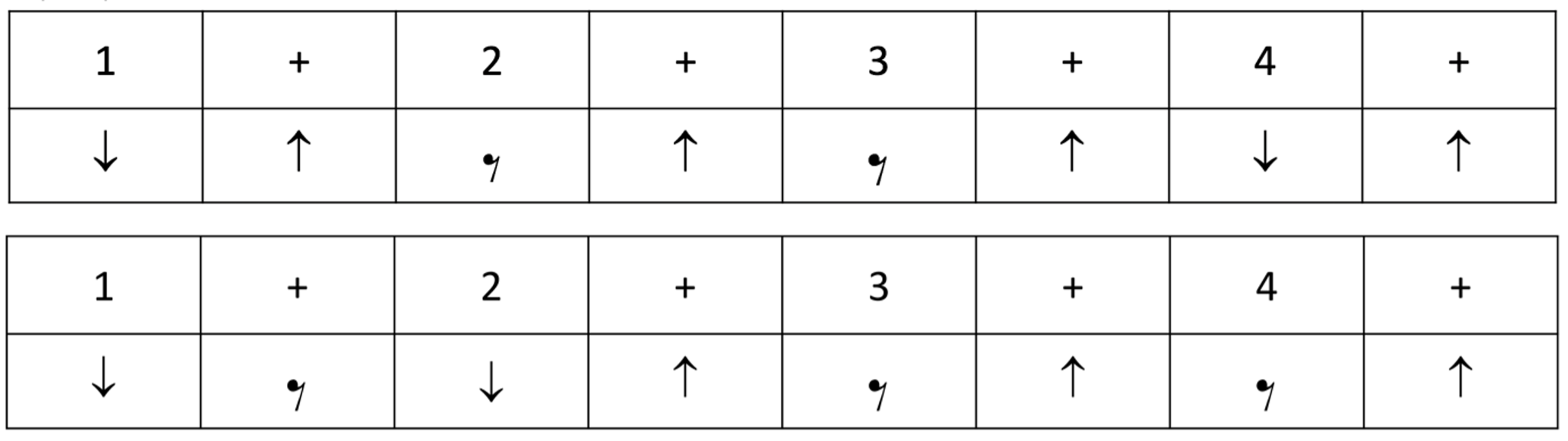
Experiment with this form of syncopation by placing the rests at various points in the bar. Below, two possible iterations, the second option introduces a third quaver rest. These rests can also be placed on the offbeat which would reduce the density of the texture without creating syncopation.
Acciaccaturas, appoggiaturas, and rubato
Acciaccaturas (1 or 2 pre-emptive crushed strums before the beat) or appoggiaturas (stretched or elongated strums on the beat) were introduced as an additional textural device. Time can be stretched even further with rubato, not only for expressive purposes but also to accommodate clients who may not be able to maintain a consistent beat.
Mixing & Matching
Experiment with mixing and matching between accents, rests and other expressive techniques to create a range of textures. It may help initially to write some patterns out, then work towards adjusting small elements in real time while playing.