Voicing Hand
As well as fretting notes and chords, the voicing hand can create a variety of muting effects. Successfully fretting a chord requires a minimum amount of pressure. If the pressure is slightly under this threshold, the note will sound unclear, and the string will make a buzzing sound. If the pressure is significantly below this threshold, it will produce a soft dull thud that is barely audible, especially if other strings are sounding clearly. While this is often an initial barrier to producing a clear sound on the guitar, harnessing this feature and using it judiciously vastly expands the harmonic and textural possibilities.
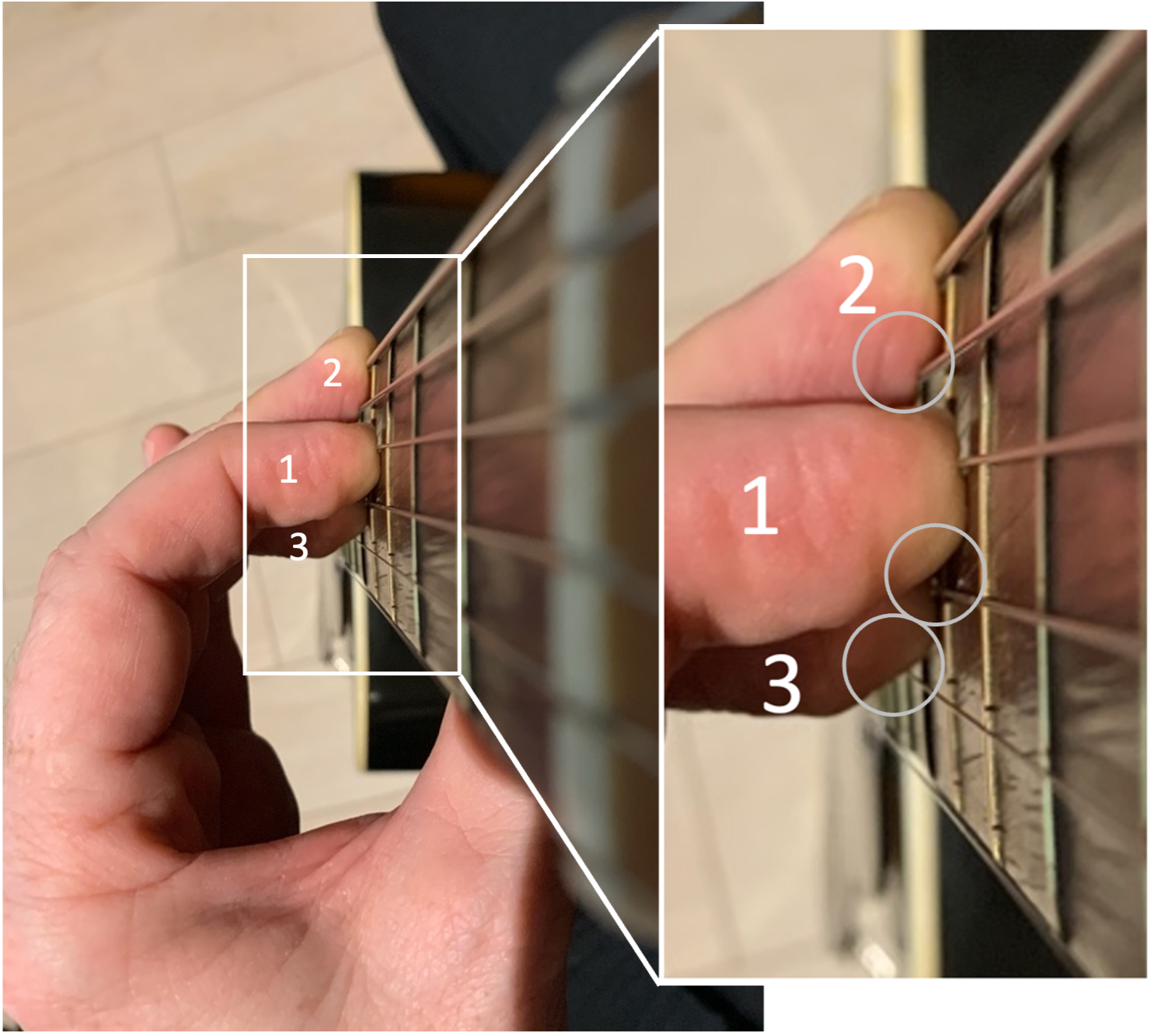
String selection and omission. One method can be used to isolate strings not needed in a chord. The thumb could be used to muffle the 6th string in D major in a modified thumb-over to play D/A rather than D/E. Another application uses the soft pad of the finger to mute an adjacent string not needed for the chord as in Figure 75. In this example, the second finger is fretting the 6th string and gently touching the 5th string to mute it as it is not needed. Note the first finger is fretting the 4th string cleanly without touching the 3rd or 4th strings. Similarly, the third finger is cleanly fretting the3rd string without touching the 2nd string.