Voicing Hand
Turn-around
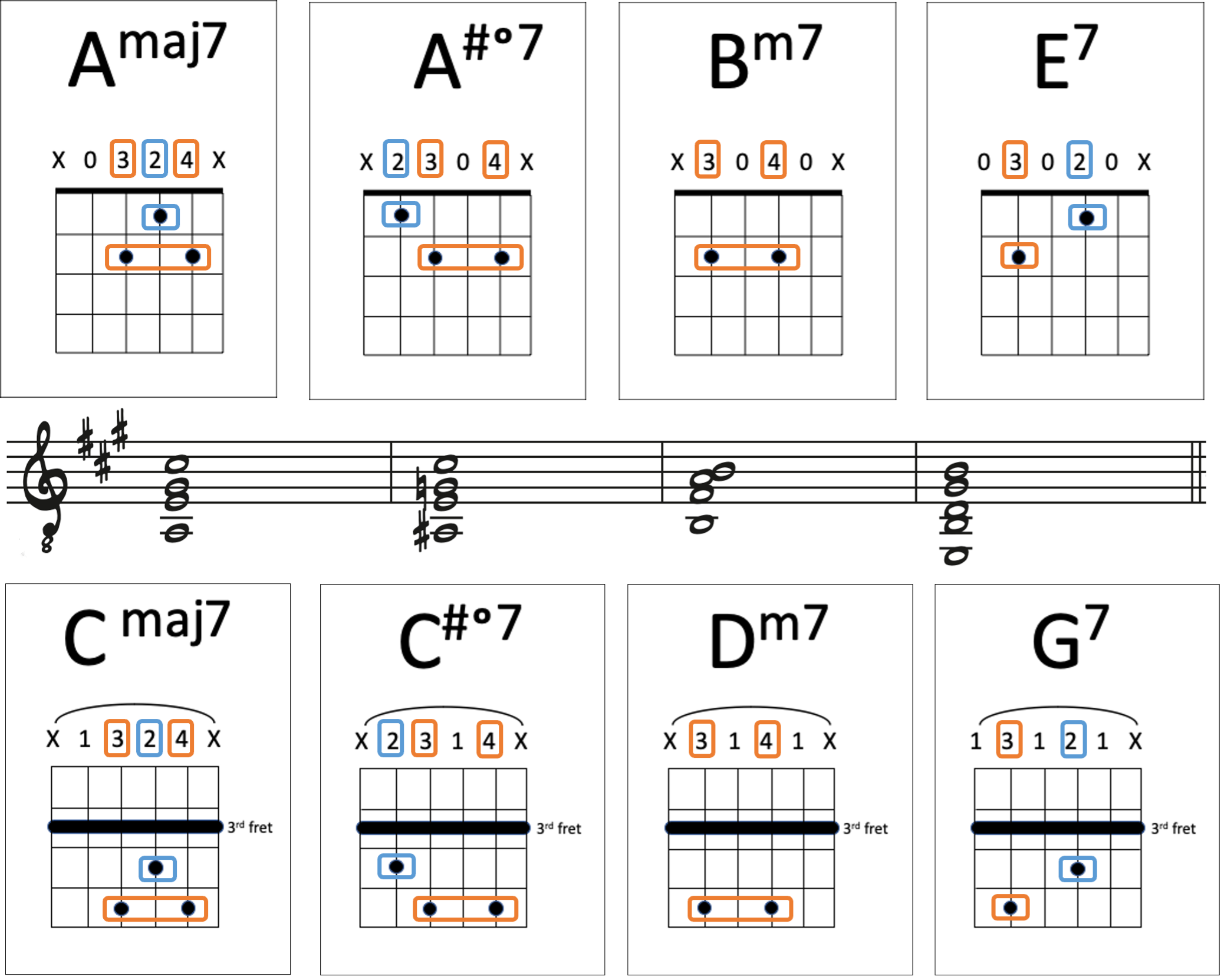
This looping turn-around chord progression features a more advance model of pivot fingers. Once mastered, looping chord progressions such as this allow the guitarist to concentrate on responding to the musical interaction rather than worrying about the next chord in the harmonic progression.
This chord progression was selected to establish the pivot concept as the chord shapes are neatly divided into two sets of pivots, indicated by blue and red squares. The blue and red section assist participants to identify elements of the fingering and voicing that:
remain in place, such as the red box from A major 7 to A# diminished
move in formation, such as the red box from A# diminished 7 to B minor 7
move independently, such as the blue box from A major 7 through to E dominant 7
remain in position linking the last chord back to the first chord to reinforce the loop in the chord progression, the blue box from E dominant 7 back to A major 7.
The fingering is still colour coded in Figure 1 but they could not be linked in the same squares as they were in previous diagrams. Initially appearing more complex, this labelling reveals a simplicity in the application of this loop. The second finger is blue throughout while the third and fourth work together in the red. The first finger is not colour coded as the barre simply replaces the open strings, and does not change within the chord progression. This interaction between the blue and red illustrates the capacity of considered fingering to unlock voicings that appear complicated at first glance.