

Chapter 3 – Music
Music philosopher Stephen Davies (2001) discusses the roles of the composer and the performer in determining the final outcome of a musical performance placing musical works on a spectrum that stretches from thick to thin.
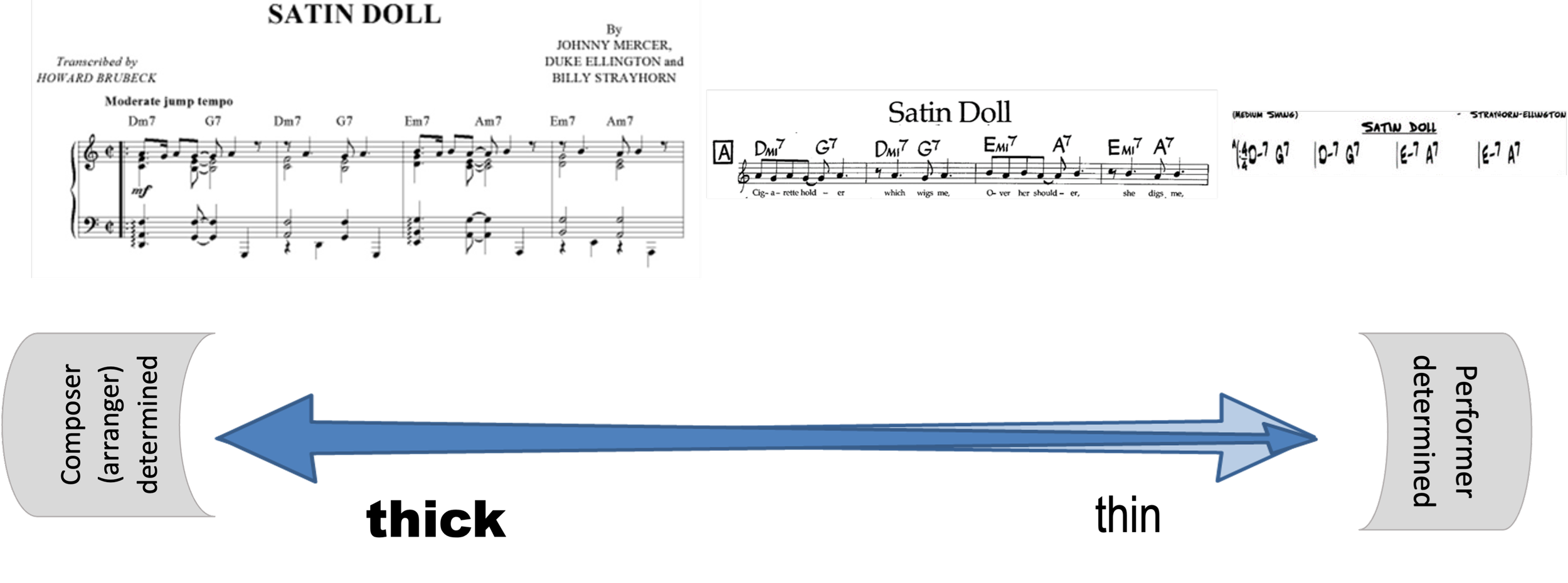
This is not specifically about texture, it is about the level of prescriptive detail provided in the score. This diagram uses different scores of Ellington & Strayhorn’s Satin Doll to demonstrate this concept.
The first score sits at the thick end of the spectrum where everything is specified down to the finer details. The arranger has prescribed the tempo, the rhythm, articulation and dynamics. The texture of a 6-part arrangement, the grand staff implies the instrumentation is piano.
The middle score is essentially the top melody line and chord progression from the previous score. The rhythm of the melody has been simplified. Instrumentation, accompaniment and phrasing have been delegated to the performer(s).
Finally, the score at the thin end of the spectrum is significantly less prescriptive providing only metre and a chord progression. Even the melody is delegated to the performer.
This score is from a trad jazz book where the lead player would play their interpretation of the melody at the beginning and end of the song. Everyone in the band then take turns improvising melodies based on this progression.
The performer(s) at the thin end of the spectrum are granted a significantly higher level of stylistic licence in determining the instrumentation, form, texture and dynamics and ultimately the character of the performance (Blom, 2006; Davies, 2001). This is in stark contrast to the thick end, where performers carry out musical instructions as prescribed by the composer and/or arranger.