

Chapter 1
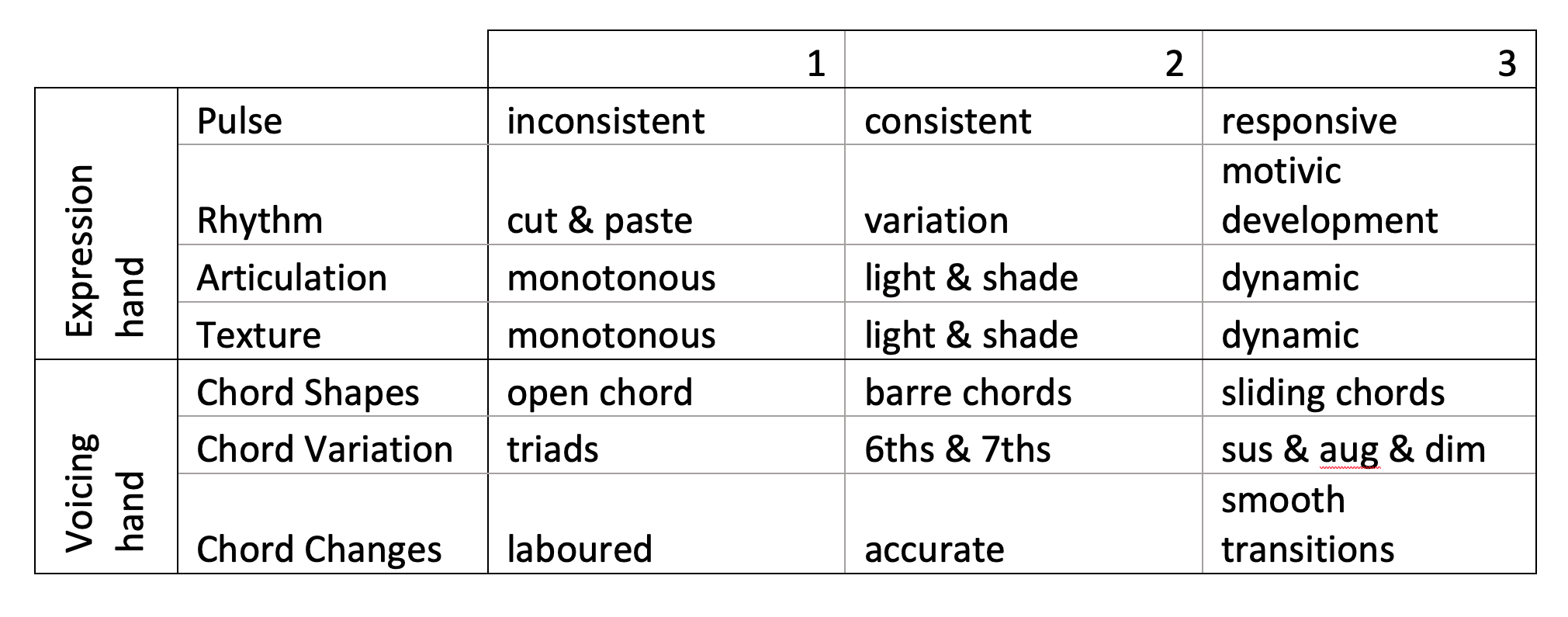
Expression Hand
The Expression hand determines when and how the notes are played. An effective right hand can drive the therapeutic process by making micro adjustments to music.
Pulse
Establishing and regulating the pulse is an essential skill in driving the therapeutic process.
Inconsistent – often in the early stages of learning the guitar, it can be difficult to coordinate all the component skills to establish a steady pulse.
Consistent – as the guitar becomes more comfortable to play, a steady pulse is maintained.
Responsive – at an advanced level, the pulse can be altered in response to the therapeutic situation.
Rhythm
Arrangements and patterns of long and short notes played in relation to the pulse.
Cut and paste – short rhythmic figures are often employed however initially may be the same bar repeated without any variation, as though cut and pasted.
Variation – some rhythmic variation is emerging, however largely based on the initial pattern.
Motivic Development – starting with a pattern/motif, then developing this to guide the therapeutic process.
Articulation
Subtle variations such as accents or other ornamentations help to form connection.
Monotonous – constant notes with no change, deviation, accents or ornamentations.
Light and shade – some accents and other ornamentations beginning to emerge.
Dynamic – increasing complexity using a range of accents and omissions to enhance engagement and drive the therapeutic process.
Texture
Rudimentary guitarists often work with block chords. More dynamic texture facilitates more responsive playing.
Monotonous – strumming across the six strings indiscriminately.
Light and shade – starting to isolate treble and bass strings to create a three-dimensional texture.
Dynamic – isolating single strings with various combinations of strings, intentional use of density to enhance engagement and drive the therapeutic process.
Voicing Hand
The Voicing Hand determines which notes are played. This is often based on chord shapes.
Chord Shapes
Basic chords in first position is a good starting point, however progressing beyond this point opens up further possibilities.
Open chords – using only the rudimentary chord shapes (e.g. E, A, D, G) combining open strings with two to three fingers, all chords played in the first three frets.
Barre chords – using barre chords based on basic chord shapes E and A, or even C for more advanced guitarists. Barre chords can be played up and down the fretboard, accessing different timbres.
Sliding chords – using more complex chord shapes that can move up and down the fretboard by stopping all strummed strings and/or dampening undesired strings to access a broad range of voicings and timbres.
Chord variation
Employing different types of chords beyond the triad to access more flexible harmonic structures.
Triads – basic major and minor chords comprising of the 1, 3, 5.
6ths and& 7ths – introducing simple chord extensions.
Sus, aug and& dim – expanding the harmonic vocabulary to incorporate suspensions augmentations, and diminished chords, and compound extensions (e.g. 9th, 13th etc.). These may be as part of the main chord or as passing notes.
Chord changes
The ease at which guitarists change from one chord to the next.
Laboured – struggling, needing to place each finger individually. Losing time, or even stopping to prepare the next chord.
Accurate – changing chords with accurate timing to maintain the harmonic rhythm, even if preceding beat is omitted to create time to transition.
Smooth transitions – transitioning between chords with ease regardless of complexity.
The Guitar Technique Rating (GTR) measures component guitar skills that facilitate flexible and responsive guitar playing across the expression and voicing hands as depicted in Figure 1. For right-handed guitarists, the left hand primarily determines the voicing, i.e., selects which notes are played. The right hand determines the expressive qualities, i.e., how the notes are played. These hands are reversed for left-handed guitarists. To ensure the GTR is accessible to both left and right-handed guitarists, the terms ‘Voicing Hand’ and ‘Expression hand’ were adopted in the development of this tool.
Seven skills (four in the expression hand and three in the voicing hand) are rated out of three for a maximum total score out of 21. A score of one indicates the skill is not yet fully established. Two indicates the skill is at a functional level and three indicates an advanced level where the participant can manipulate that component skill flexibly to respond to the musical stimuli and guide the musical and therapeutic direction.